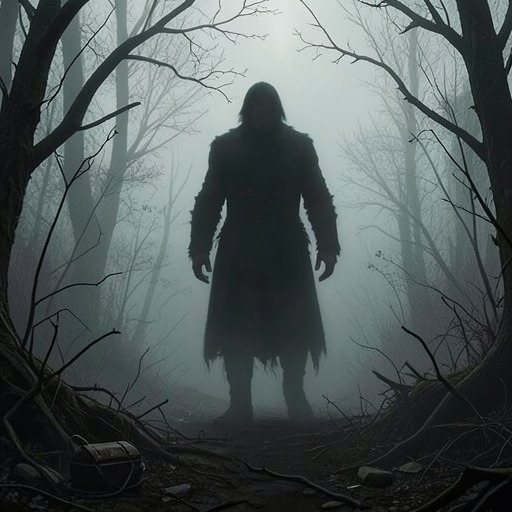
God is an idea, and the devil is us
The Thicket“God is an idea, and the devil is us” is Shorty’s most direct statement of moral skepticism and human responsibility. He offers it after Jack Parker wonders whether burying the dead can compensate for killing a murderer, turning a local act of mercy into a larger argument about where good and evil reside. The expression rejects the comfort of an external moral ledger without denying the seriousness of human conduct: if God is an idea, then the devil is not an independent force that excuses people, but the violence people themselves perform.
The Immediate Scene
The expression emerges after a trading-post gunfight in which Jack Parker, Shorty, Sheriff Winton, and Jimmie Sue confront the consequences of violence. Jack has helped kill one of the attackers, while Hog has attacked the man afterward. The group then restores light to the damaged post, brings Katy’s body down, and attempts to provide Christian burials for the bartender, the man Jack shot, and the fragmented remains of the other dead. Jack speaks inherited funeral words over Katy and later over the makeshift graves, even though he doubts the sincerity of the blessings he offers. Shorty challenges the moral logic behind this ritual. When he asks whether burying “those unfortunate people” can make up for killing a murderer, Jack admits that it might be his thinking. Shorty’s reply is therefore not an abstract theological lecture. It is an intervention in a concrete dispute about guilt, ritual, and responsibility, made while bodies are still being gathered from the wreckage of the fight.
Conflict with Inherited Faith
Jack’s religious outlook comes largely from Grandpa, whose endurance has made him firm in his belief that the dead will be seen again in heaven. Grandpa has buried children, preached funerals, butchered animals, witnessed death among the Cheyenne, survived the smallpox, and endured the killing of Grandma by a cow. His faith offers a stable explanation for catastrophe and teaches Jack not to think too independently, because independent thought might lead to ideas that are correct but unpleasant. That inherited faith also appears in Jack’s belief in Predestination. He accepts that the tornado destroyed the ferry, Grandpa was shot and killed, Lula Parker was taken, and Jack nearly drowned as parts of God’s plan. Shorty’s expression cuts against this explanation. If suffering has already been assigned by divine design, worry and action seem unnecessary; if moral accounting is left to God, human beings can imagine that their deeds will eventually be measured elsewhere. Shorty instead locates moral danger in people and their choices, refusing to let theology absorb the consequences of what they do.
Violence, Labels, and Human Responsibility
The surrounding world repeatedly demonstrates why Shorty’s claim matters. Cut Throat Bill is described through newspapers and dime novels as a notorious bank robber who may once have ridden with Frank and Jesse James, while popular stories turn him into a hero. The speaker who reports this history insists that there are no heroes. Public labels, sensational stories, and prices on criminals’ heads simplify people into legends or targets, but the actual consequences are physical and intimate: robbery, kidnapping, murder, and fear. The same process appears in the treatment of Bobby O’Dell. A crowd drags him through the street, fastens a rope around his neck, and adjusts the noose while he protests that his mother is not to blame. His hanging is carried out as communal spectacle rather than formal justice. The crowd’s participation makes the scene an early demonstration of Shorty’s principle: evil does not require a supernatural devil when ordinary people can organize cruelty, supply its tools, and approve its timing. Racist and dehumanizing language intensifies this moral failure. At Fatty Worth’s table, a man declares that “Niggers and pigs both have a smell about them,” and Eustace Cox answers by redirecting the insult toward the speaker’s own filth. Fatty also reduces the people around him to sexual and racial abuse, while rumors about Cut Throat Bill’s gang circulate through racialized descriptions and threats. Such language does not merely describe the world; it helps create categories of people whom violence can be directed against. The expression therefore carries a social meaning as well as a theological one: the devil is reproduced through human contempt, habit, and collective permission.
Ritual after Atrocity
The burial scene gives the expression its ethical pressure. Jack does not abandon ritual simply because he doubts that ritual can erase violence. He says that even the worst people deserve a few good words, imagining that they may have loved their mothers or a dog and perhaps believed in Jesus. He ends with “Dust to dust and such,” then privately imagines that the dead have gone straight to hell. The contradiction is central. Jack performs a Christian duty while recognizing that the ceremony cannot make the killings clean or restore the dead. Sheriff Winton shares this refusal to leave the bodies exposed. He insists that the dead deserve burial, including a woman whose drawers have been pulled off and a man left in his underwear, and he takes responsibility for digging. Shorty mocks him as a gentleman, but Winton’s action supports the same human-centered moral burden that Shorty articulates. No supernatural judgment is visible in the woods; the living must decide what decency requires and carry it out with shovels, lanterns, and exhausted hands.
Final Expansion beyond God
The expression’s meaning broadens near the end of Jack’s journey. After Shorty’s death, Jack climbs the telescope tower in the late dark and looks through Shorty’s telescope at a star-filled sky. He remembers Shorty’s hope that some part of a man might reach Mars, then understands that Shorty no longer wanted that kind of escape because he had become happy and, Jack thinks, had come to believe in love even without coming to believe in God. Looking at the stars, Jack realizes that his old image of God, heaven, harps, and angels is too small for the blackness and immensity before him. This is not a simple conversion to Shorty’s atheism. Rather, Jack moves beyond the narrow religious picture inherited from Grandpa toward something stranger and harder to explain. Shorty’s aphorism prepares that movement by relocating moral meaning from a heavenly authority to human beings, while the stars leave Jack with a reality larger than either conventional doctrine or easy disbelief. The expression thus survives as an ethical proposition: people cannot wait for God or blame the devil for what they choose to do, even when the universe remains mysterious.